Saturday, December 11, 2010

Boy


“Boy” is an autobiography by the famous author Roald Dalh.  “Boy” chronicles the first twenty years of Roald Dalh’s life.  I was hesitant before reading this book because I have never enjoyed an autobiography.  This book is extremely well written and was a great read.
Dalh captures the reads attention immediately by telling a story about his father.  In the story his father who brakes his arm and when the doctor, who is drunk, tries to fix it he mistakes the fracture for a dislocated shoulder and does irreparable damage.  The arm had to later be amputated. 
As the story continues Roald Dalh explains different events of his life.  Many of them deal with pranks he played on others.  One prank in particular stands out.  Dalh and his friends tried to place a dead mouse in a candy jar of a women they did not like.  They boys were caught and got in a lot of trouble by the principle. There are some parts of this story that are a little disgusting, such as when he was getting his tonsils removed or when a boy he meet was getting a boil removed. 
I was amazed by how much detail Dalh, who was sixty-eight when he wrote the book, was able to put in the book.  It was also very evident that Roald Dalh used some of his experiences in life in his books.  As I read this book, I could not help but think of different novels that Dalh wrote. 
This book would be a great way to introduce autobiographies or an author study to older students.  It is a very fun read and students would be able to learn a lot of information from it.  It is important to introduce students to entertaining autobiographies so they can develop a love for them. 

Thursday, December 9, 2010

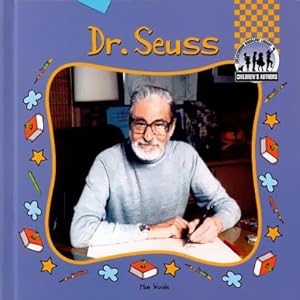
Dr. Seuss


            This is a great children’s biography about Theodor Seuss Geisel, who was known as Ted to friends and known as Dr. Seuss by millions.  This biography is a very easily read book that has a lot of information about Dr. Seuss, whose full pen name is Dr. Theophrastus Seuss.  This book explains how Dr. Seuss got his name, how he became a beloved children’s book author, and highlight many of his books and accomplishments. 
            This autobiography explains that Ted Geisel went to school at Dartmouth and Oxford to become a teacher.  After talking to his soon to be wife Helen Palmer, Ted decided to follow his passion of illustrating and writing.  He sent his first book, “And To Think That I Saw It On Mulberry Street”, to twenty-seven different publishers and we rejected by all of them.  Just when Ted was about to give up hope on becoming an author a friend, who just happen to be an editor at Vanguard Press, published the book.  Dr. Seuss was an instant star. 
            The biography discusses Teds work in the army during World War II.  Ted worked on political cartoons and to crate education films for the army.  During his carrier Ted won different awards such as the multiple Peabody Awards, two Academy Awards, was nomination for the Caldecott Award, two Emmy Awards, and a Pulitzer Prize.
            Ted and his publisher also founded Beginner Books, which is an easy reader series.  The first book Ted wrote for this series was “The Cat in the Hat”.  This is why on the cover of each of the Beginner Books is a picture of The Cat in Hat. 
            This books only takes a few minutes to read, but is packed full of information.  I was so fascinated by the life of Ted Geisel, the man known as Dr. Seuss that I read this book three times after getting home from the library.  I would strongly recommend this book to anyone interested in Dr. Seuss, any teacher doing an author study on Dr. Seuss, or anyone interested in a good book. 

Here is the Coral Reef


            “Here is the Coral Reef” is education book about the underwater world of the coral reef.  This book uses a combination of lyrical verses and repetition that explores and reinforces the lesson of interdependence amongst creatures that live by the coral reef.  Madeleine Dunphy begins with a simple sentence “Here is the coral reef.”  As the reader turns the pages more and more information is added to the beginning sentence that explains how the creatures rely on each other to live.  By the last page, the interdependences of the creatures that live in the coral reef comes full-circle when the eel hides in the coral reef from the shark. 
            Tom Leonard illustrated breath taking pictures for this book.  Each picture represents the next stage in the circle of life.  The illustrations are extremely realistic and are an accurate representation of size and color of the actual animals that live by the coral reef.  One of the most interesting things about the pictures in this book is that each picture gives a hit about the next creature in the interdependence cycle by having that create somewhere on the page.  It is fun to try to guess what creature will be included on the next page. 
            The very last page of the books has a picture of each of the animals and plants described in the book.  There is also a caption that explains that the coral reef is threatened by human activity, and even gives a help line if the read wants to have more information.  I believe this last page would be more informative if the captions about the animals not only had their pictures and names but also information about them. 
            This would be a great book to read laud to younger students.  Because of the repetitiveness of the passages the students would be able to easily recite many parts of the book.  This would keep them very engaged and entertained.  This is also a very good book to use when talking about life cycle and interdependence amongst animals in a habitat. 

Lemons Are Not Red


            “Lemons Are Not Red” by Laura Vaccaro Seeger is a very cute book about the wonderful world of color.  This is a simple beginner book which walks the reader through ten different objects and what color they are.  This seems easy enough, but Seeger does this is an extremely creative way.  The first two pages say, “Lemons are not RED”.  Both of these pages are yellow, with a cut out of a lemon.  The Lemon looks to be read because the next page is red.  When the reader flips the page they cut out of the lemon is now yellow and the text explains, “Lemons are YELLOW/Apples are RED.  The illustration shows a red apple.  The next two pages are similar to the first two, but this time the pages are orange and there is a cut out of a carrot.  The reader can see that the next page is purple.  Can you guess what is purple?
            Another interesting thing about this book is each pair of objects is related in some way.  The apple and lemon are both fruits, the carrot and the purple thing you are guessing about are both vegetables.  This is a great way to get younger children using clues and predicting about what will come next in the story. 
            Even though the illustrations in this book are very simple, they are very well done.  Each page that has a cut out on it has one solid color on each side.  Brush strokes can be seen on the other pages.  This give the book texture and makes it much more aesthetically pleasing.  This book would be wonderful to read aloud to younger student to have them make predictions or younger students could read it on their own.  All of the big words have either a picture or a color associated with them to help younger readers decode the meaning of the word. 

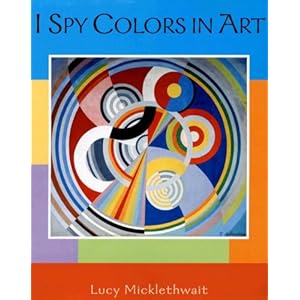
I Spy Colors in Art


            “I Spy Colors in Art” is a very fascinating and initiative book.  The book takes the reader though different famous art work and says a simple statement, “I spy with my little eye…”.  The stamen goes on to explain a color and corresponding object in the picture.  The only other text on the page is a caption proclaiming the painters name and title of the art piece.  I instantly liked this book because it was having very young readers look critically at famous works of art.
            This is a series of books that was created because the author liked to show her children famous paintings.  Micklethwait quickly realized that her children learned a great deal just by looking at the pictures.  Sometimes they would even point out things in the picture that she did not notice.  She loved categorizing art work with his children by categories such as happy or sad pictures.  After realizing the joy her children received from this simple game, she wanted to share their experience with the world. 
            This would be a great way to start a unit on art of any grade.  My roommate, who is an art teacher, explained to me that the first thing learned in art criticism class is to actually look at the art.  He said one of the assignments he gives his students is to write down every detail in a piece of art as if you were describing it to a person who could not see.  This book reinforce this appreciation of art to younger readers.  If this book sounds interesting and fun, Micklethwit has also written three other books exploring shapes, numbers, and the alphabet in different famous works of art.